
Self Serve Sign-up


About The Project
Sojern leadership wanted to explore a self-serve sign-up workflow for years as a way to acquire smaller hotel customers without requiring a traditional sales process. The challenge was that a true self-serve experience would require significant changes across Product, Engineering, Finance, Commercial, and onboarding operations.
Rather than build the infrastructure first, I proposed and led a lightweight market test to help us understand if hotel marketers would actually complete signing up.
Challenge
From the customer's perspective, self-serve looked simple. Internally, contracts, billing, qualification, account creation, tracking implementation, and campaign activation all depended on assisted workflows.
Before investing in automation, we needed evidence that customers would actually move through the experience without sales involvement, including accepting commercial terms and providing payment information.
Strategy
Test the riskiest assumption with the smallest viable investment.
I partnered across Marketing, Finance, Commercial, Legal, and Product to recreate enough of the experience to measure real customer behavior without requiring a full Product or Engineering build.
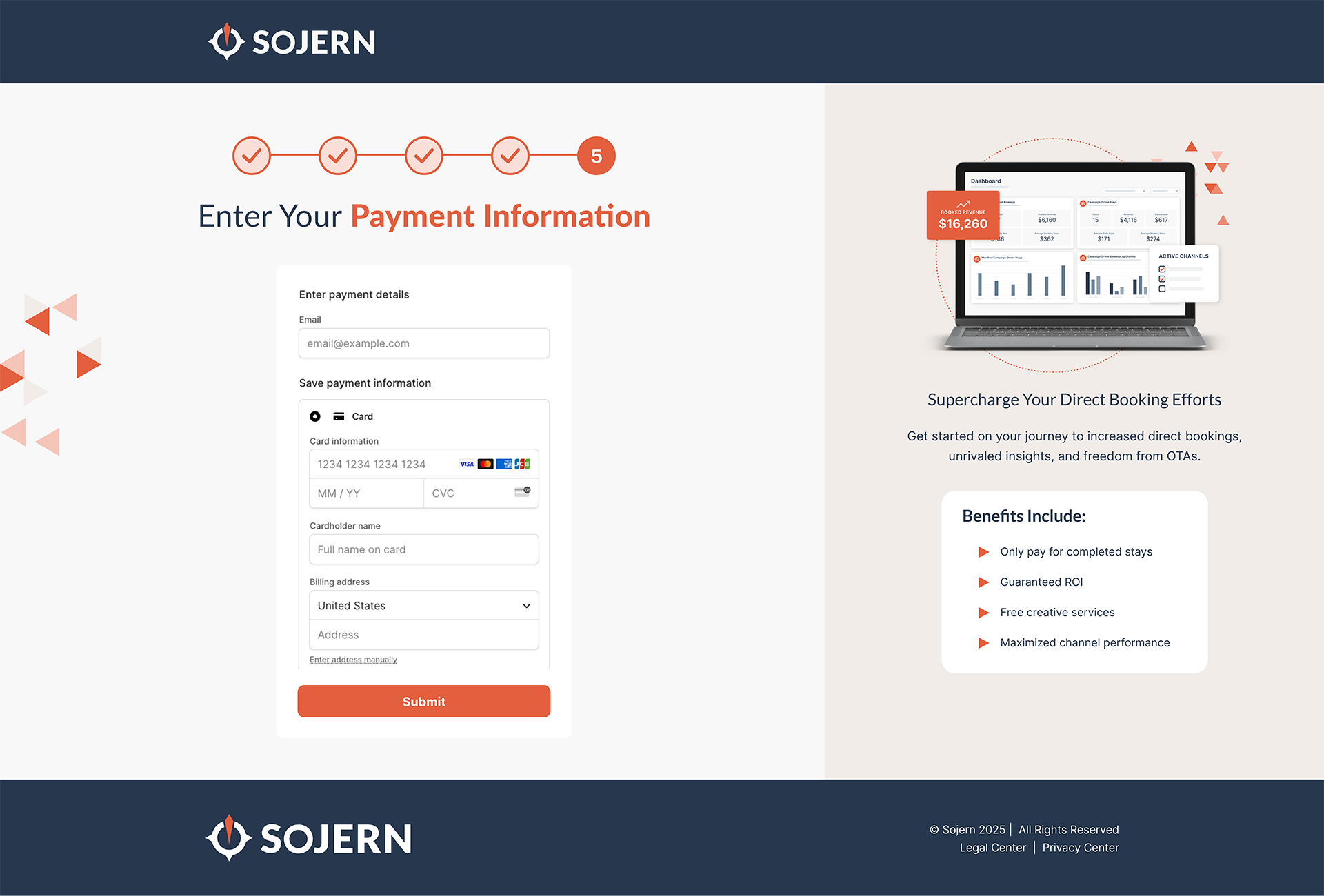
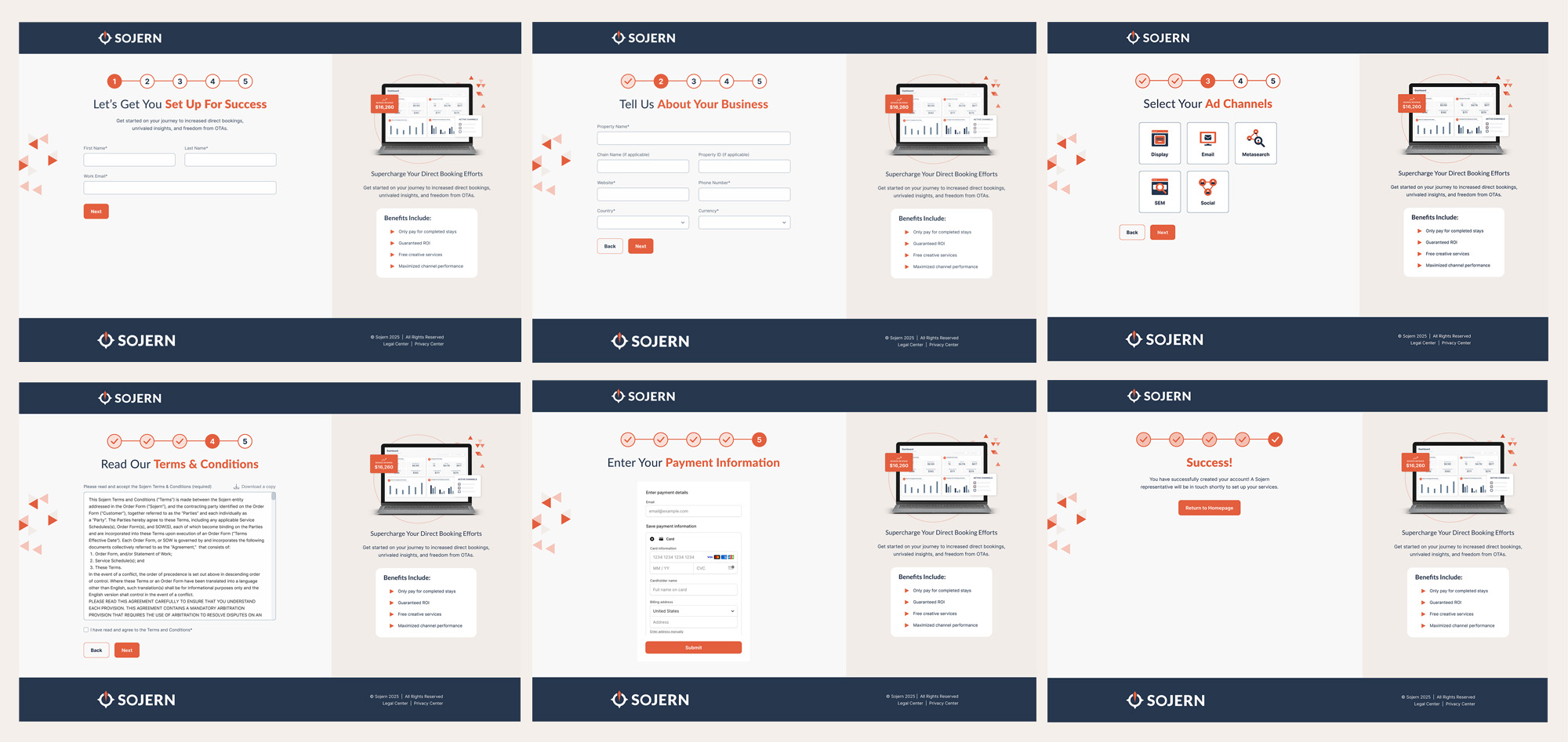
Paid campaigns drove hotel advertisers into a multi-step sign-up experience, while existing tools and manual internal workflows handled what would eventually require automation.
Key Decisions
Test before building
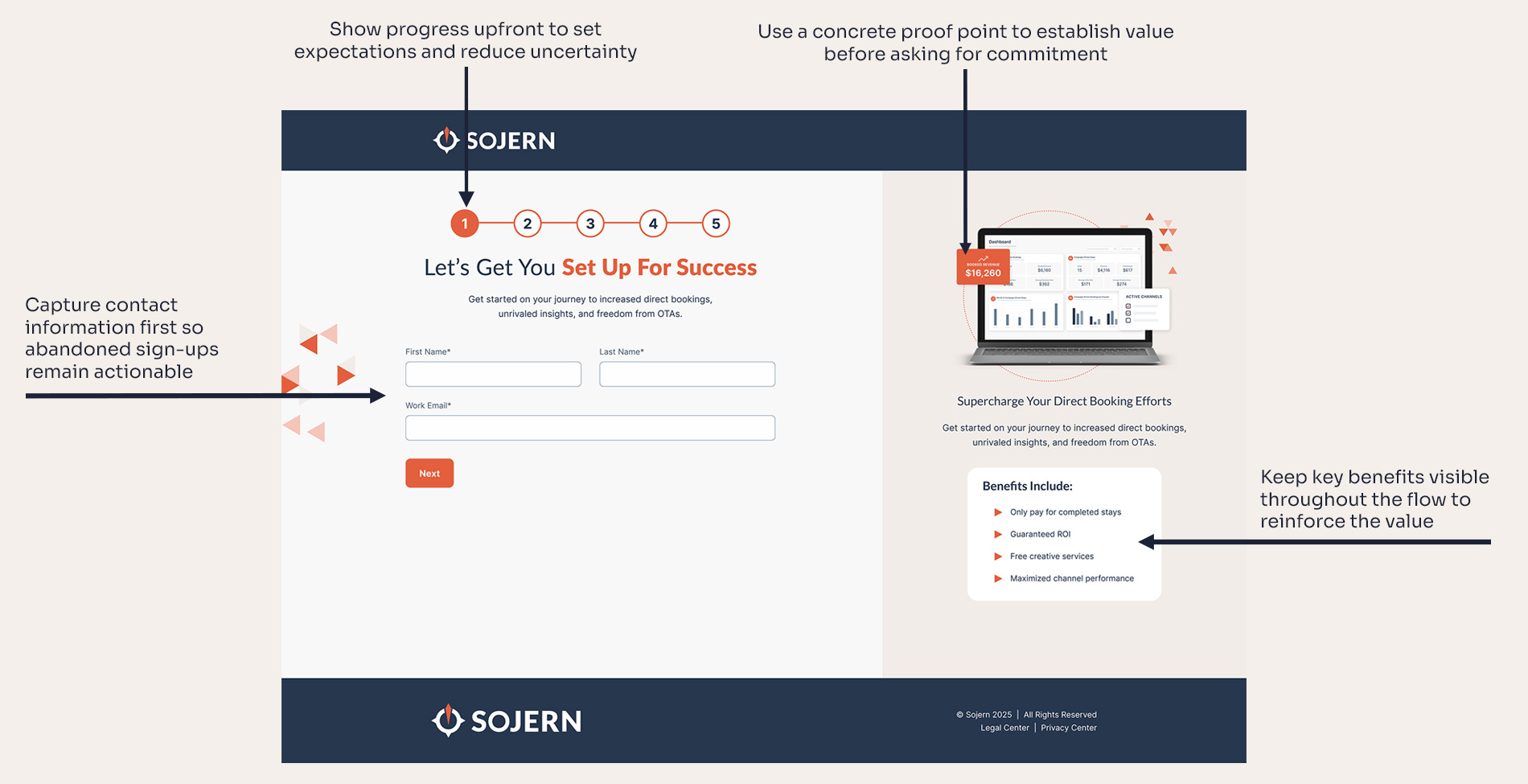
The full experience would have required meaningful Product and Engineering investment. I intentionally kept the initial test lightweight so we could validate demand before solving the infrastructure problem.
Measure commitment
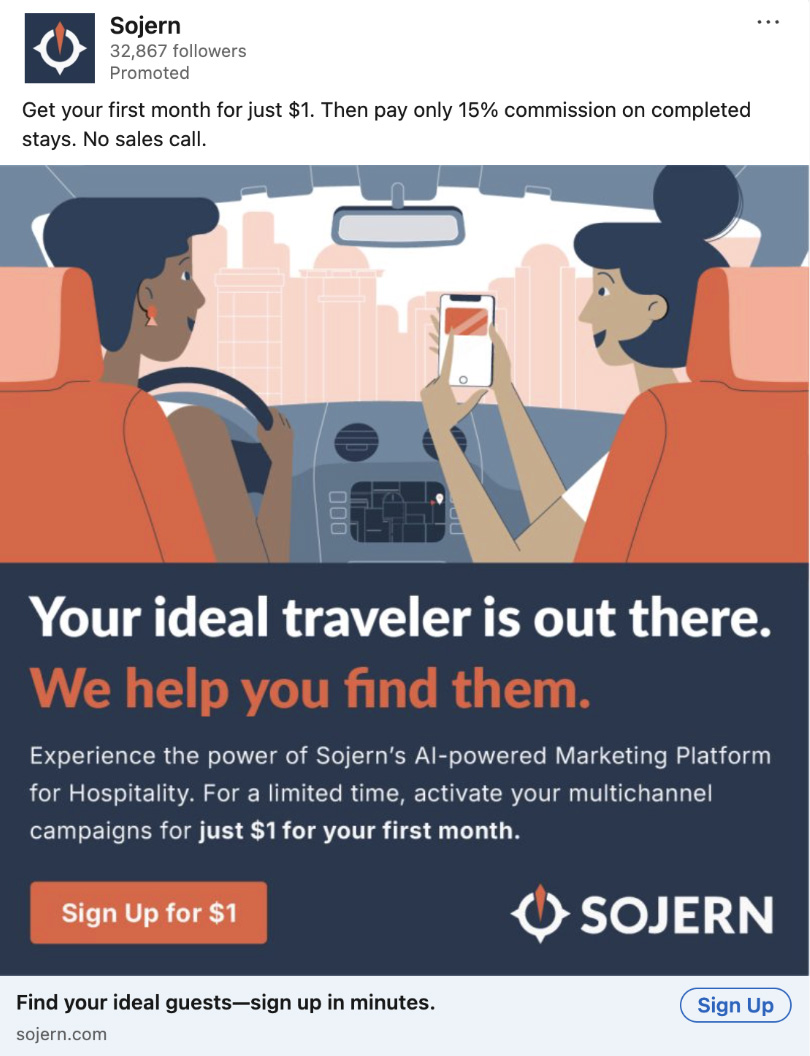
Rather than survey customers about whether they would use self-serve, we put a real offer in market and measured whether they would progress through terms and payment.
Create and adapt the funnel
I defined measurement at each stage so we could identify where users dropped rather than treating the final conversion as the only signal.
Channel selection was removed after the first two weeks when it appeared to introduce unnecessary friction, and contact information was moved earlier so incomplete sign-ups could still be analyzed and retargeted.
Results & Learnings
Interest in the solution was validated. The self-serve purchase model was not.
Paid campaigns showed that customers were interested in a faster, lower-friction way to get started.
- LinkedIn CTR: 0.48%
- LinkedIn creative emphasizing speed and “skip the sales call” reached 0.53% CTR
- Google CTR: 2.70%
- 151 paid-media users started the self-serve experience
But interest dropped sharply as users moved toward commercial commitment.
- 657 Step 1 events
- 237 progressed to Step 2
- 13 completed the non-payment portion of the form
- 2 submitted payment
- 0 successful payments
One prospect specifically abandoned at payment after deciding the 15% commission did not provide enough value compared with OTA commissions. Sales later converted that lead at a lower rate.
The test also confirmed that a scalable self-serve model would require much more than a signup form. Qualification, contracting, payment processing, Salesforce setup, account creation, tracking, and onboarding still depended heavily on manual operations.
Outcome
- Tested a long-standing executive hypothesis without requiring a full product build
- Validated customer interest in lower-friction acquisition messaging
- Identified payment and perceived commercial value as major barriers
- Exposed operational dependencies that would need to be redesigned before self-serve could scale
- Gave leadership behavioral evidence to guide future investment rather than relying on assumptions
Role & Contributions
Led the self-serve acquisition test from hypothesis through launch, including experiment strategy, success criteria, funnel design, competitive research, tooling evaluation, targeting, measurement, and cross-functional coordination.
Partnered with Meaghan Sandtorv, who designed and built the web experience, while I provided content direction, visual guidance, and feedback on the signup flow.




.svg)
